
Považský Castle
Dare to discover the landmark above the Váh Valley
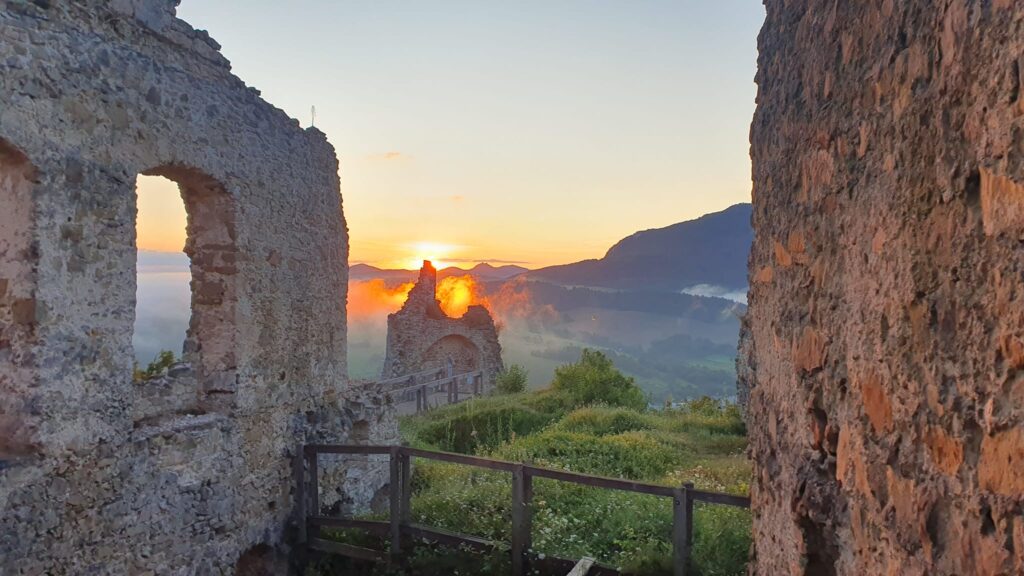
Považský Castle rises on a steep hill above the village of Považské Podhradie, just north of Považská Bystrica. Although only ruins remain today, its distinctive silhouette continues to dominate the landscape – especially for those travelling through the Váh Valley towards Žilina.
At an elevation of approximately 497 metres above sea level, the castle is easily accessible via a pleasant walk suitable even for less experienced hikers. The final, steeper ascent is rewarded with impressive panoramic views of the Váh Valley, the town of Považská Bystrica, and the surrounding countryside.
Bystrický or Považský Castle?
Visitors often encounter two names for the site – Bystrický Castle and Považský Castle. Both are historically correct. The castle was first mentioned in 1300 as castrum Bistrizza, meaning “Bystrický Castle.” Today, however, it is more commonly known as Považský Castle.
Its significance is reflected in its inclusion among the Seven Wonders of the Trenčín Region in 2009.
Guardian of the Považie Region
The castle was built in the second half of the 13th century, most likely on the initiative of King Béla IV following the Mongol invasions. It served as an important defensive stronghold, protecting key trade routes and the wider Považie region.
Among its most notable owners was Matúš Čák of Trenčín, who controlled the castle in the early 14th century. It later came into the hands of Stibor of Stiborice, who significantly expanded the complex and added a Gothic palace. After his death, the castle returned to royal ownership and was also held by the queens of Kings Sigismund of Luxembourg and Albrecht II.
In 1458, King Matthias Corvinus returned the castle to the nobility, marking another turning point in its history.
The Podmanicky family: power and legends
The Podmanický family left the most lasting mark on Považský Castle, owning it for nearly a century. The brothers Ján and Rafael Podmanický became particularly well known as so-called robber knights. At the height of their influence, they controlled more than 400 estates and seven castles in the Považie region.
They are also associated with the legend of the abduction of the Polish noblewoman Hedviga, an event said to have led to the castle being set on fire. While legend suggests the brothers later reformed, historical reality was likely more complex.
After the death of Rafael Podmanický in 1558, the family line died out and the castle once again passed into royal hands.
From fortress to ruin
A major fire in 1543 severely damaged the castle, and reconstruction continued into the late 16th century. At that time, it belonged to the Balaš family, who successfully defended it during the Estates’ uprisings.
In the 17th century, they built a Renaissance manor house below the castle, which still stands today. However, the Tököli uprising proved decisive: imperial troops heavily damaged the castle, and in 1689 the estate was confiscated. From that point on, the castle was no longer maintained and gradually fell into ruin.
A new life for the ruins
Archaeological research and restoration work carried out between 2011 and 2012 marked the beginning of the castle’s revival. Since 2017, Považský Castle has once again been open to the public.
Today, visitors can enjoy a newly added observation deck equipped with a telescope, offering sweeping views of the Bytča Basin, the Manín Gorge, the Súľov Rocks, and the Hričov Canal – a true highlight of any visit.
How to reach the castle
- By car: Drive to Považské Podhradie, where parking is available near the church or at the Burg Manor.
- By public transport: Take a train or bus to the Považské Podhradie – Kaštieľ stop from Považská Bystrica.
- On foot: A marked educational trail and a yellow hiking path lead from the church to the castle. The walk takes approximately 20 minutes and, although steeper towards the end, is suitable for families with children.