
Lednica Castle
Dare to venture where the road ends
Lednica Castle is not a place you simply arrive at – it is a place you discover. The journey itself is part of the experience, leading through a narrow, ten-metre-long tunnel carved directly into solid limestone. Once protected by a drawbridge, it now opens into a space that feels raw, dramatic, and unlike any other.
Perched high on a steep rocky cliff above the village of Lednica, the castle’s location made it one of the most inaccessible strongholds in Slovakia. Here, the road truly ends – and beyond lies only the wild landscape of the White Carpathians: forests, rock formations, and stories that have endured for centuries.
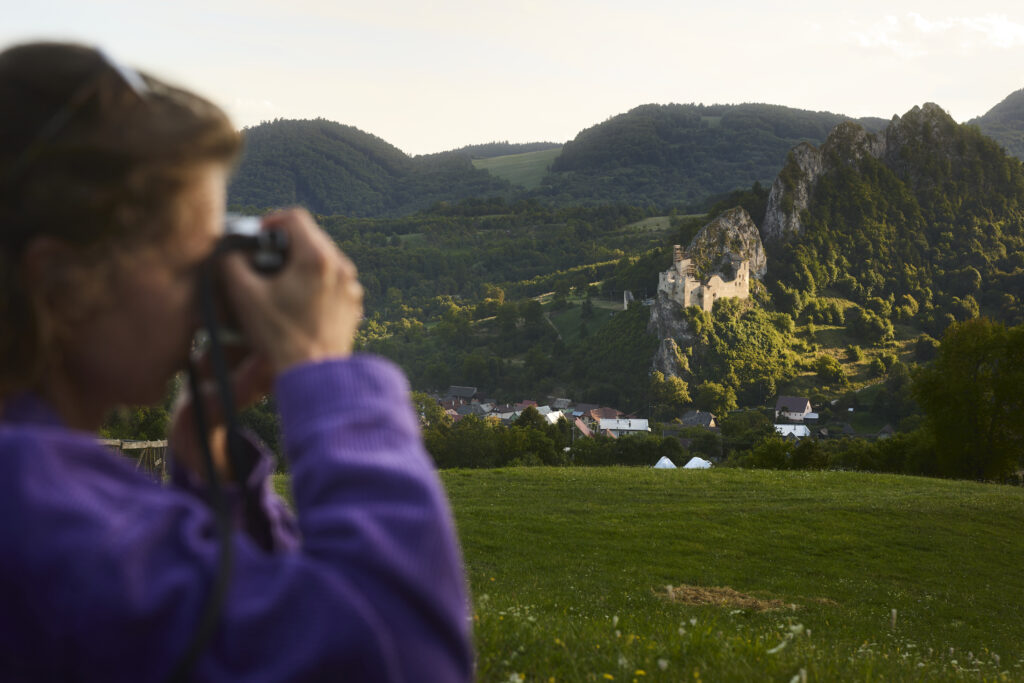
A guardian of borders and noble life
Lednica Castle was founded in the mid-13th century as a strategic guard post on the north-western border of the Kingdom of Hungary, overseeing an important trade route to Moravia. The first written mention dates back to 1259, although archaeological findings confirm that this site had been inhabited for over 2,000 years. As early as the 9th century, a Slavic fortified settlement stood here, laying the foundations for the later castle.
The castle complex was arranged in three ascending sections. The lower part served defensive and practical purposes, housing bastions, stables, a carriage house, and a blacksmith’s workshop. The middle castle formed the centre of daily life – a place of governance, gatherings, and feasts – connected by a passage carved directly into the rock.
From here, a path led further upward to a lookout point offering sweeping views of the surrounding landscape. Today, visitors can reach it via a steel ladder and steps cut into the rock – a rewarding ascent for those seeking both adventure and unforgettable views.
Ownership, conflict and decline
The first known owner of Lednica Castle was Marek, Governor of Lednica. In the following years, it came under the control of Matúš Čák of Trenčín, who ruled over an extensive network of castles in the region.
Ownership later passed through several noble families, including the Pakšiovci, Sobekovci, Bielikovci, Podmanickí, and Maťašovskí. At times, the castle also served as a base for robber knights, a phenomenon not uncommon in the Považie region.
Its decline came during the anti-Habsburg uprisings. After their suppression in 1710, imperial troops set the castle on fire. Although it resisted complete destruction for some time, it gradually fell into ruin and by the early 20th century stood abandoned.
New life for old walls
Today, Lednica Castle is undergoing a remarkable revival. Since 2004, systematic restoration and conservation efforts have been carried out by the Historical-Astronomical Society, the village of Lednica, and dedicated volunteers.
The transformation is ongoing — with each visit, new sections are stabilised, walls rebuilt, and the site steadily restored. Lednica stands as a testament to the power of community and the enduring value of cultural heritage.
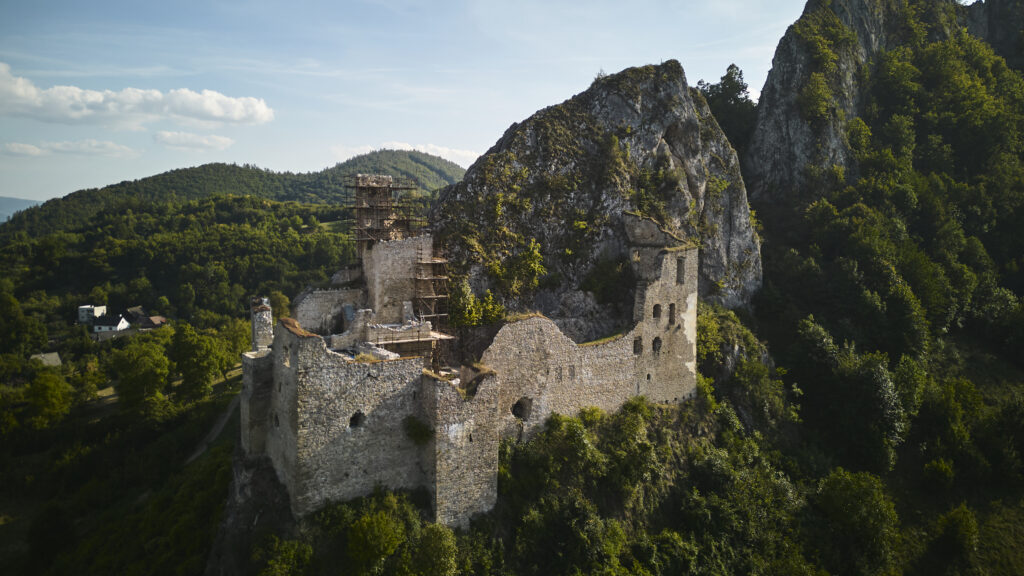
The Straka (Magpie) lookout
The highest point of the castle is a lookout known as ‘Straka’. Reached via a steel ladder and narrow rock-cut steps, it rewards visitors with panoramic views of the village of Lednica, the Lednica Rocks, and the sweeping landscape of the White Carpathians.
However, the castle is also home to rare bird species, including Eurasian eagle-owls and peregrine falcons. During nesting season, access to the lookout may be temporarily restricted — a reminder that nature still sets the rules here.
Katarínka’s Spring: a legend of love and sacrifice
Along the path to the castle lies Katarínka’s Spring, tied to one of the region’s most poignant legends.
According to tradition, Katarína of Lednica was engaged to a gamekeeper named Andrew. When the lord of the castle claimed the right of the first night and had her brought to him, she chose death over betrayal. She leapt from the castle walls, and where she fell, a spring of clear water is said to have emerged.
The spring still bears her name today, and local stories tell of a figure in a white wedding dress appearing on quiet evenings among the ruins.
The site was also visited in 1675 by Jan Amos Comenius, who came to see the local preacher Mikuláš Drábik. Today, a commemorative plaque marks his visit, and several local schools bear the name of the “Teacher of Nations.”
The legacy of Katarína endures as well — her story is reflected in the coat of arms of the village of Lednica, keeping the legend alive to this day.
How to reach the castle
Lednica Castle rises directly above the village of Lednica, approximately 16 kilometres from Púchov. A marked trail leads from the village centre, passing Katarínka’s Spring and continuing up to the castle cliff.
The castle is open from April to October. Access to the Straka Lookout is weather-dependent and undertaken at visitors’ own risk; it is not suitable for small children. Parking is available in the village, and the nearest bus stop is about a 10-minute walk away.